Measurement plan
Define primary and secondary events around business outcomes.

Marketing data is useful only when events represent real user actions and tags fire consistently. Sync Soft Solution provides digital analytics services for UK businesses, including GA4, Google Tag Manager, form tracking, campaign tagging and conversion QA. We focus on making reporting easier to trust rather than creating dashboards full of disconnected metrics.
Every engagement starts with the same question: what is stopping the next stage of growth? We use that answer to prioritise the right combination of research, implementation, content, development and measurement rather than forcing every business into an identical package.
Define primary and secondary events around business outcomes.
Organise tags, triggers and variables with clear naming and QA.
Review events, conversions, data streams and reporting settings.
Ensure advertising platforms receive the right conversion signals.
Standardise source, medium and campaign naming.
Test firing behaviour and identify obvious duplicate or missing events.
Businesses searching for digital analytics services UK usually need more than a list of deliverables. They need to understand what will be changed, how the work connects to their wider marketing, which responsibilities sit with the agency, and how progress will be judged. We structure the service around those practical questions.
Before adding tags, we define what the business needs to know: which campaigns generate qualified enquiries, which landing pages convert, where ecommerce users drop out, or which service pages assist sales. This prevents tracking dozens of events that never influence a decision.
A form submission or purchase may be a primary outcome, while a scroll or button click is usually a supporting signal. When every interaction is treated as a conversion, automated bidding and reporting can become misleading. We separate these event types carefully.
Over time, containers can accumulate duplicate tags, unclear triggers and outdated scripts. We use consistent naming, document important changes and test tags so future maintenance is easier. Consent and privacy requirements should also be reviewed in relation to the tools and jurisdictions involved.
A dashboard can show what changed, but the useful layer is interpretation. We structure reporting around acquisition, conversion and business outcomes so the next action is clear: increase budget, fix tracking, improve a landing page, change targeting or investigate lead quality.
We review the website, current marketing activity, analytics, competitors, priority services and the commercial goal. This helps separate symptoms from root causes. A traffic problem may actually be an indexation issue; a PPC problem may be weak conversion tracking; a conversion problem may be unclear page messaging.
Recommendations are organised around likely value, urgency and implementation dependency. Technical blockers come before content expansion when they prevent crawling or conversion. High-intent pages are prioritised before broad awareness content when the immediate goal is lead generation.
Where access allows, our digital marketing and development capabilities can work together. This is useful when a recommendation requires template changes, tracking code, landing page creation, redirects, schema updates or performance improvements.
Performance is evaluated using the metrics that fit the service and business model. We look for what changed, why it likely changed and what should be improved next. This keeps the programme iterative rather than treating the initial plan as fixed forever.
We do not guarantee a specific Google position, AI citation, number of leads or advertising return because those outcomes depend on competition, demand, budgets, platform behaviour, sales follow-up and many factors outside an agency’s direct control. We can commit to transparent scope, evidence-led decisions, quality implementation and clear reporting.
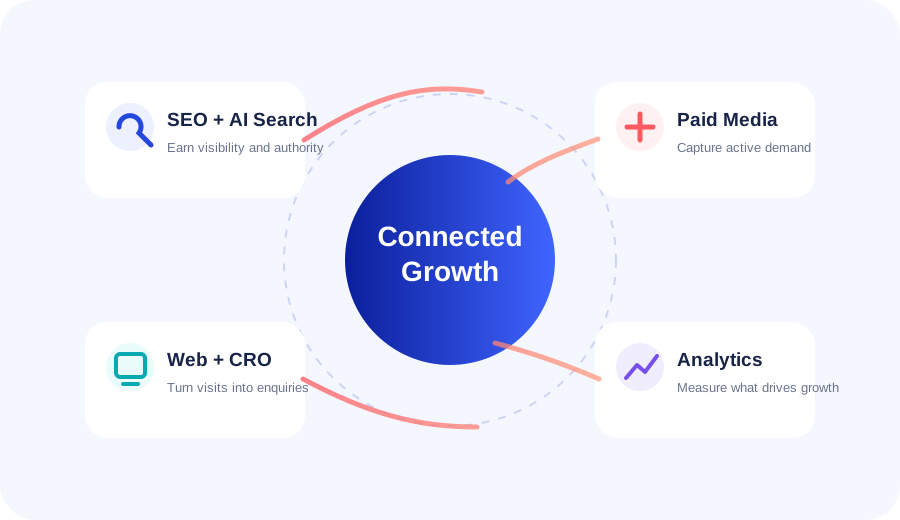
Analytics & Tracking UK can perform better when the surrounding website, content, tracking and acquisition channels support the same goal. That is why Sync Soft Solution combines digital marketing with web design and development rather than treating implementation as somebody else’s problem.
Straight answers to common questions before a project starts.
Share your current site, target locations and the service or product you most want to grow. We will use that information to shape a practical scope rather than sending a generic package.