GEO opportunity map
Identify the questions and comparison journeys where AI answers may influence buyers.
Generative Engine Optimisation (GEO) focuses on making a brand’s information easier for AI-driven search and answer engines to find, interpret and reference. Our GEO services for UK businesses combine structured content, entity clarity, technical SEO, topical depth and credible external signals. GEO is treated as part of a broader search strategy, not a guaranteed shortcut into AI answers.
Every engagement starts with the same question: what is stopping the next stage of growth? We use that answer to prioritise the right combination of research, implementation, content, development and measurement rather than forcing every business into an identical package.
Identify the questions and comparison journeys where AI answers may influence buyers.
Create concise answers backed by deeper supporting detail and evidence.
Build connected coverage around services, problems, comparisons and decision criteria.
Improve headings, internal links, schema and entity relationships.
Strengthen credible references and consistent brand information beyond the website.
Review citations, branded prompts, AI referrals and changes in conventional search.
Businesses searching for generative engine optimisation UK usually need more than a list of deliverables. They need to understand what will be changed, how the work connects to their wider marketing, which responsibilities sit with the agency, and how progress will be judged. We structure the service around those practical questions.
The most useful GEO opportunities often come from questions people ask before making a decision: which provider is suitable, what a service costs, how options differ, what risks exist, and what should be considered before buying. We map these decision points and identify where your current site provides weak, indirect or incomplete answers.
A generative system needs to understand the relationship between your organisation, services, people, locations, products and expertise. Consistent naming, informative About and service pages, structured data, internal linking and corroborating third-party sources can all help reinforce those relationships.
Short direct answers, tables, definitions and FAQ sections can improve extractability, but they should not turn the page into a list of disconnected snippets. We combine concise answers with detailed context so the page remains persuasive and genuinely useful to a human visitor.
AI platforms expose different levels of referral and visibility data. We therefore use a blended measurement framework that can include AI referral traffic, branded prompt checks, observed citations, organic search movement, assisted conversions and broader authority improvements.
We review the website, current marketing activity, analytics, competitors, priority services and the commercial goal. This helps separate symptoms from root causes. A traffic problem may actually be an indexation issue; a PPC problem may be weak conversion tracking; a conversion problem may be unclear page messaging.
Recommendations are organised around likely value, urgency and implementation dependency. Technical blockers come before content expansion when they prevent crawling or conversion. High-intent pages are prioritised before broad awareness content when the immediate goal is lead generation.
Where access allows, our digital marketing and development capabilities can work together. This is useful when a recommendation requires template changes, tracking code, landing page creation, redirects, schema updates or performance improvements.
Performance is evaluated using the metrics that fit the service and business model. We look for what changed, why it likely changed and what should be improved next. This keeps the programme iterative rather than treating the initial plan as fixed forever.
We do not guarantee a specific Google position, AI citation, number of leads or advertising return because those outcomes depend on competition, demand, budgets, platform behaviour, sales follow-up and many factors outside an agency’s direct control. We can commit to transparent scope, evidence-led decisions, quality implementation and clear reporting.
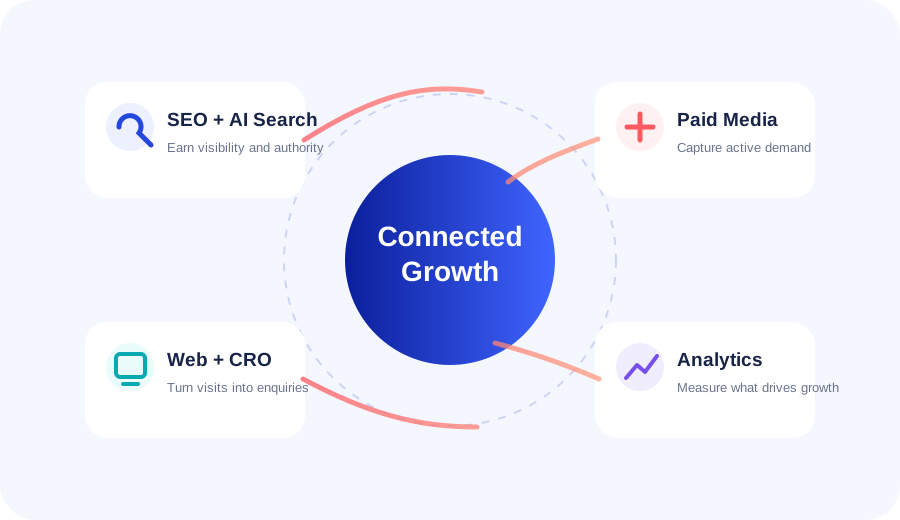
Generative Engine Optimisation UK can perform better when the surrounding website, content, tracking and acquisition channels support the same goal. That is why Sync Soft Solution combines digital marketing with web design and development rather than treating implementation as somebody else’s problem.
Straight answers to common questions before a project starts.
Share your current site, target locations and the service or product you most want to grow. We will use that information to shape a practical scope rather than sending a generic package.