Campaign architecture
Structure budgets around services, markets and intent.

Google Ads can put your business in front of people actively searching, but automated bidding does not remove the need for strategy. Sync Soft Solution manages Google Ads for UK businesses with close attention to search intent, campaign structure, location targeting, negative keywords, conversion accuracy and landing-page experience.
Every engagement starts with the same question: what is stopping the next stage of growth? We use that answer to prioritise the right combination of research, implementation, content, development and measurement rather than forcing every business into an identical package.
Structure budgets around services, markets and intent.
Identify useful queries and exclude irrelevant demand.
Write and test responsive search assets with clear message match.
Align campaign geography with genuine service coverage.
Review primary and secondary conversion actions.
Improve speed, relevance and lead capture.
Businesses searching for Google Ads agency UK usually need more than a list of deliverables. They need to understand what will be changed, how the work connects to their wider marketing, which responsibilities sit with the agency, and how progress will be judged. We structure the service around those practical questions.
Campaigns and ad groups should reflect the way you need to allocate spend and evaluate performance. Over-consolidation can hide important differences between services or locations; excessive fragmentation can starve campaigns of data. We choose a structure based on search volume, budget and business priorities.
Broad matching and automated bidding can discover useful demand, but they can also spend on irrelevant queries. Regular search-term analysis, negatives and lead-quality feedback are essential controls for many lead-generation accounts.
PMax can be useful, especially for ecommerce and some multi-channel objectives, but it should not be treated as a black box. We review asset groups, audience signals, conversion goals, feed quality where relevant and the interaction with branded and search campaigns.
Ad relevance continues after the click. Strong pages repeat the core promise, answer likely objections, provide evidence and make the next step obvious. We can adjust content, forms and page structure when conversion friction is limiting paid performance.
We review the website, current marketing activity, analytics, competitors, priority services and the commercial goal. This helps separate symptoms from root causes. A traffic problem may actually be an indexation issue; a PPC problem may be weak conversion tracking; a conversion problem may be unclear page messaging.
Recommendations are organised around likely value, urgency and implementation dependency. Technical blockers come before content expansion when they prevent crawling or conversion. High-intent pages are prioritised before broad awareness content when the immediate goal is lead generation.
Where access allows, our digital marketing and development capabilities can work together. This is useful when a recommendation requires template changes, tracking code, landing page creation, redirects, schema updates or performance improvements.
Performance is evaluated using the metrics that fit the service and business model. We look for what changed, why it likely changed and what should be improved next. This keeps the programme iterative rather than treating the initial plan as fixed forever.
We do not guarantee a specific Google position, AI citation, number of leads or advertising return because those outcomes depend on competition, demand, budgets, platform behaviour, sales follow-up and many factors outside an agency’s direct control. We can commit to transparent scope, evidence-led decisions, quality implementation and clear reporting.
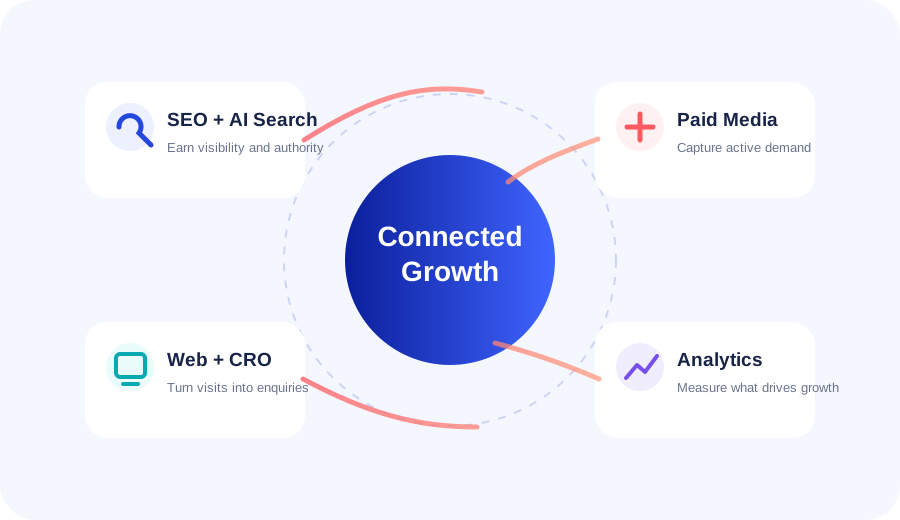
Google Ads Agency UK can perform better when the surrounding website, content, tracking and acquisition channels support the same goal. That is why Sync Soft Solution combines digital marketing with web design and development rather than treating implementation as somebody else’s problem.
Straight answers to common questions before a project starts.
Share your current site, target locations and the service or product you most want to grow. We will use that information to shape a practical scope rather than sending a generic package.